
By Debt Calculator Hub · Updated November 4, 2026 · Methods and editorial standards

Paying off debt is not only a math problem. Routines and motivation also affect whether a plan lasts. Many people know they should send extra money to debt, but the plan falls apart when progress feels too slow. The debt snowball method tries to solve that problem by making the first win easier to reach. You organize your debts by balance size, attack the smallest balance first, and use each paid-off debt as fuel for the next one.
This method may not always save the most interest compared with the debt avalanche method, but it can be powerful for people who need motivation, clarity, and a plan that feels manageable. When a debt disappears, even a small one, it changes the way the plan feels. You no longer have the same number of bills. You have proof that the plan is working.
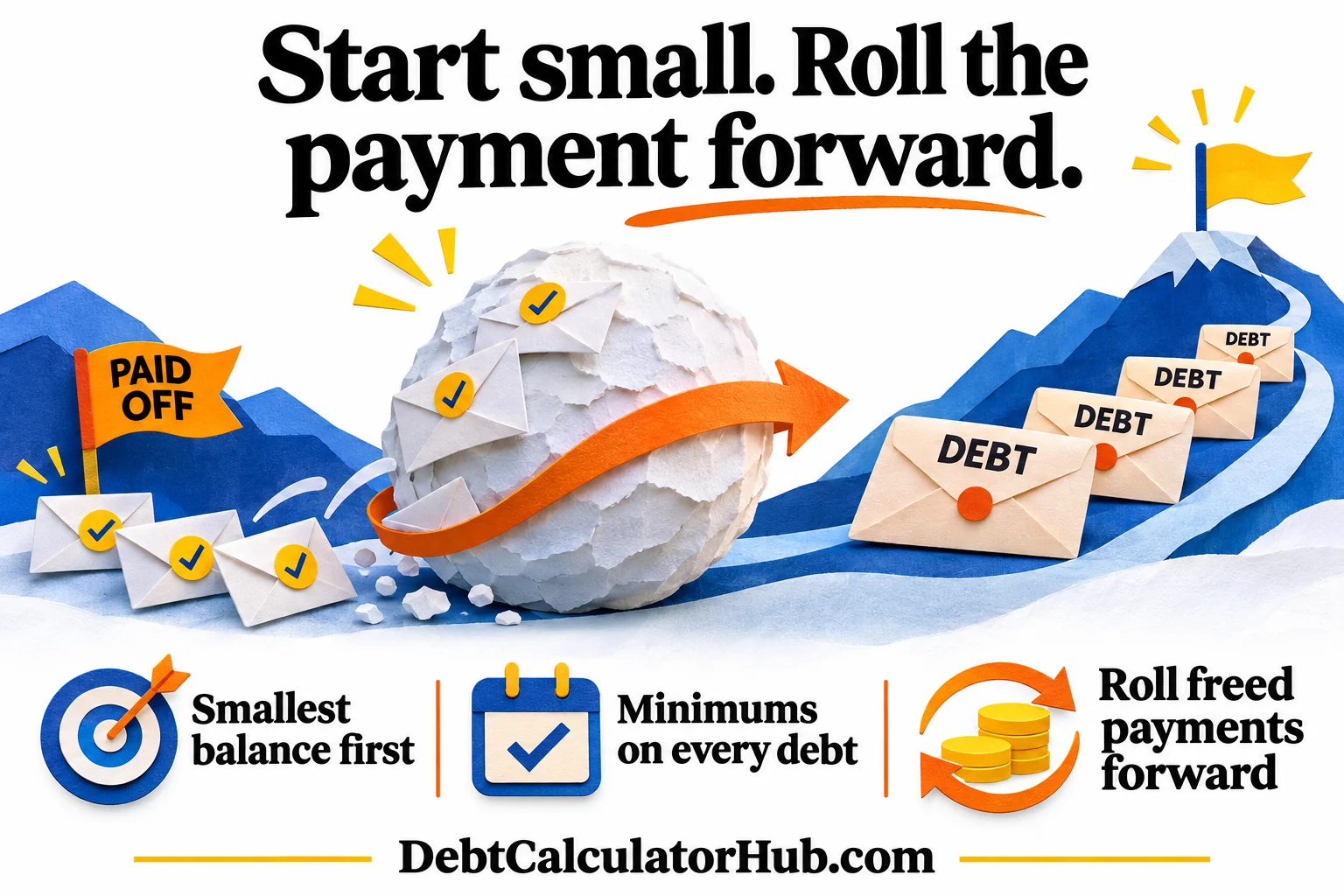
The basic steps
The snowball method follows a clear order. You do not need complicated software or a perfect budget to understand it. The main requirement is consistency.
- List every debt you want to include.
- Write down the current balance, interest rate, and minimum monthly payment for each one.
- Sort the debts from smallest balance to largest balance.
- Keep paying the minimum on every debt.
- Put any extra money toward the smallest balance.
- When the smallest debt is gone, roll its old payment into the next-smallest debt.
- Repeat until every balance is paid off.
The word snowball is used because the payment grows as you move through the list. At first, your extra payment may be small. After the first debt is paid off, the minimum payment from that old debt becomes available. You add it to the next target. Then the next old payment is added too. Over time, the payment aimed at each remaining debt gets larger.
Why quick wins matter
The biggest benefit of the snowball method is psychological. Debt can feel heavy because progress is often invisible in the beginning. If you owe several balances, sending a little money to every account may make the total smaller, but it may not change your daily experience. You still log in and see the same list of debts.
With the snowball method, the goal is to remove one debt from the list as quickly as possible. That first paid-off balance creates a quick win. Quick wins can help because they:
- make the plan feel real instead of theoretical;
- reduce the number of monthly payments you manage;
- build confidence before the bigger balances;
- give you a reason to keep sending extra money;
- turn progress into something you can see.
This does not mean the snowball method is magic. It works when you keep making the required payments and avoid adding new debt while you are trying to pay balances down. The method gives structure, but the monthly habit is what creates the result.
A simple worked example
Imagine someone has four debts:
- Store card: $600 balance, $30 minimum payment
- Medical bill: $1,200 balance, $60 minimum payment
- Credit card: $4,000 balance, $120 minimum payment
- Personal loan: $7,500 balance, $230 minimum payment
The minimum payments add up to $440 per month. Now assume the person can add $150 extra each month, making the total payoff budget $590. With the snowball method, the first target is the $600 store card. The person keeps paying minimums on the other debts and sends the extra money to the store card. Because that card is small, it may disappear quickly.
Once the store card is paid off, the old $30 minimum payment does not go back into spending. It rolls into the next target. The medical bill now gets its own $60 minimum, plus the $150 extra, plus the old $30 store card payment. That means $240 per month is aimed at the medical bill while the other debts still receive their minimums.
When the medical bill is gone, its $60 payment rolls forward too. Now the credit card receives a larger focused payment. Later, when the credit card is gone, the personal loan receives the full snowball payment. The plan becomes stronger with each debt removed.
When this method can be a good fit
The snowball method can be useful if you have several balances, feel overwhelmed, or have struggled to stay motivated with payoff plans in the past. It can also work well when your smallest debts are annoying bills you want out of your life. Removing them can create mental space and simplify your monthly routine.
The tradeoff is that the snowball method may cost more interest than the avalanche method if your largest or highest-rate debts are left for later. That does not automatically make it the wrong choice. A mathematically perfect plan only helps if you follow it. For some people, the plan they can stick with is the plan that wins.
How to start
Start by gathering accurate balances and minimum payments. Then decide how much extra you can realistically send every month. Avoid choosing an extra payment so aggressive that you have to stop after one month. A smaller amount you can repeat is usually better than a large amount that breaks your budget.
Use the calculator to test your numbers, then revisit the plan when income changes, a balance is paid off, or you can add more money. The more consistent the extra payment, the easier it is for the snowball to grow.
Keep priority separate from actual payoff order
Our snowball tool fixes the extra-payment priority using the balances you enter at the start. It still pays every active minimum before directing extra money. A larger debt with a large contractual minimum can therefore finish before the debt receiving the extra payment. That is not a missed payment or a failed strategy; it is the result of keeping all required payments current.
For example, with $1,000 at 8% and $5,000 at 24%, minimums of $35 and $150, and $115 extra, the smaller card is paid in month 7. Keeping the $300 budget then clears both debts in month 26, with about $1,655.95 interest. These figures use monthly accrual and no fees or new spending.
Build your snowball plan
Enter your balances, interest rates, minimum payments, and extra monthly amount to see your payoff order and estimated debt-free date.
Open the Debt Snowball Calculator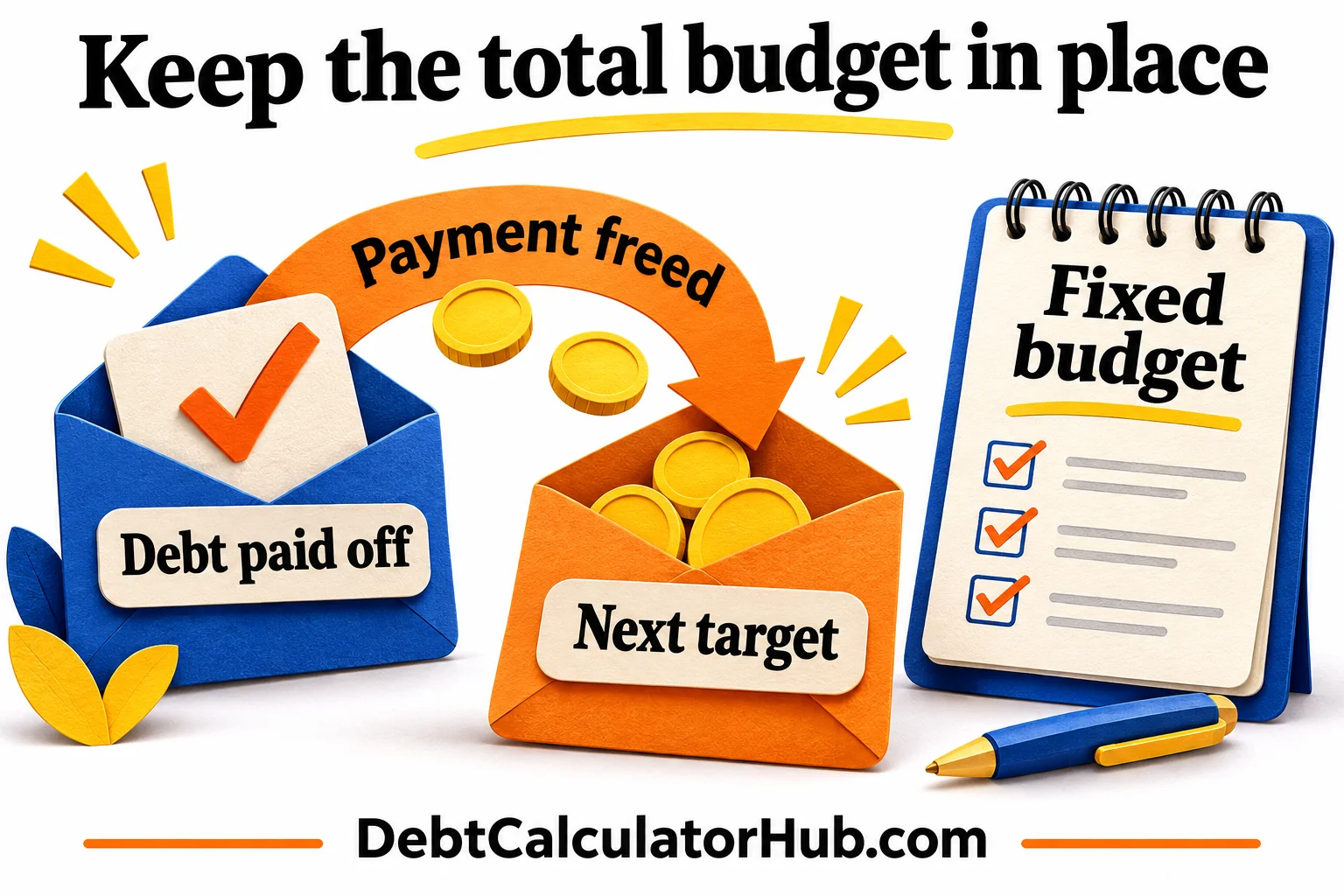
Keep a rollover ledger for the payoff month
Write down the total monthly budget before ordering debts. In the $300 example, the starting minimums are $35 and $150, leaving $115 extra. Once a debt clears, its former payment stays inside that same $300 budget; it does not become new spending money.
If only $20 remains to clear a debt when you planned to send it $150, the unused $130 can go to another debt in that month in our model. Actual payment dates may mean the transfer happens later. Keep each creditor’s required payment on time, record the smaller final payment, and check how much of the budget is still available. This ledger separates choosing a target from assuming it must be the first debt actually cleared.
Download the free complete debt payoff planner
Choose Snowball in the workbook to keep a monthly schedule and track the payments you actually make. The complete workbook supports six debts, a 120-month schedule, a selectable Snowball or Avalanche priority, month-specific extra payments, and an actual-payment log.
Download the complete free planner and guide (ZIP)
Get the workbook only (XLSX) · Prefer one debt? Get the free starter
No payment, email signup or account connection is required to download. The workbook calculates one selected strategy at a time, uses fixed starting minimums with monthly interest, and excludes new borrowing, fees, rate changes and missed minimums. It is a planning estimate, not a lender payoff quote. The ZIP includes setup instructions, a hypothetical example and a personal-use license.
Sources and calculation notes
Our examples use the simplified monthly estimates described in our methodology. For the real-world terms and details discussed in this guide, consult these primary sources:
- CFPB: steps for using the smallest-balance and highest-interest payoff methods
- CFPB worksheet: compare snowball and highest-interest payoff strategies
Reviewed October 22, 2026. Examples are illustrations, not lender offers or account-specific payoff quotes. Actual terms and results depend on your account and lender.