
How it works
Why minimum credit card payments are risky
Minimum payments can keep an account current, but they are rarely designed to get you out of debt quickly. A minimum payment is often a small percentage of the balance, a fixed dollar floor, or the greater of several statement rules. When the APR is high, a large share of that payment can go toward interest instead of principal.
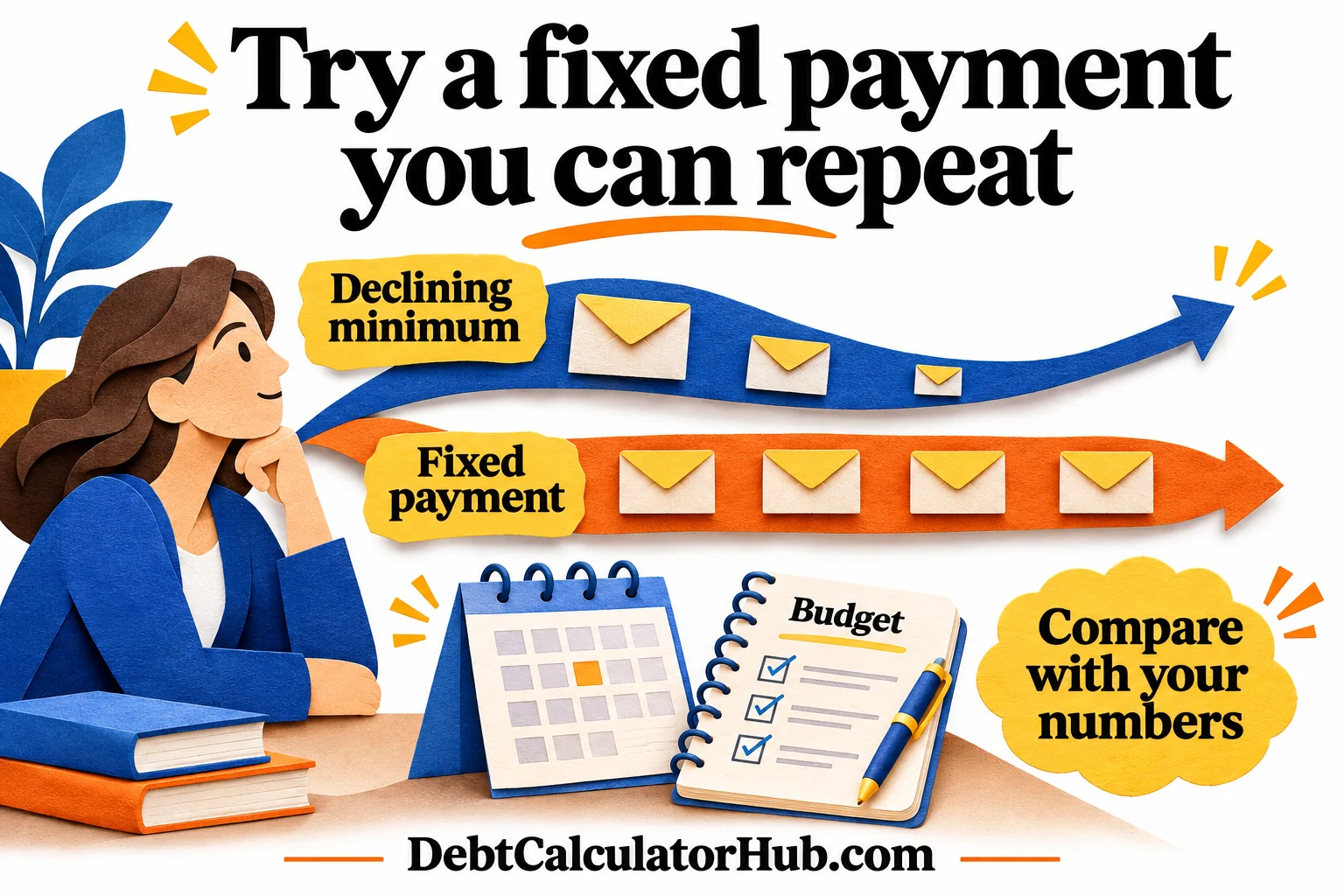
This calculator estimates a minimum-only payoff path using the balance, APR, minimum percentage, and minimum dollar floor you enter. It also shows a simple comparison with a larger payment so you can see how much time and interest may be avoided by paying more.
The result is especially useful for credit card debt because revolving balances can last for years when payments stay close to the minimum. Even if the monthly payment feels affordable, the long-term interest cost can be much larger than expected. Seeing the month count and total interest makes the tradeoff easier to understand.
Use this page as an educational planning estimate. Your actual issuer may calculate minimums differently, charge fees, or change your APR. For a stronger plan, compare this page with the main credit card payoff calculator, where you can test a fixed monthly payment or a target payoff date.
The two formulas you can test
Choose percentage of opening balance only, or percentage of opening principal plus that month's interest. Each formula is subject to your dollar floor, capped at the amount owed, and recalculated monthly. Required payments are rounded up to cents. The default is an illustration, not a statement of any bank's terms.
For $5,000 at 18% APR, the first month's modeled interest is $75. A 2%-of-balance minimum starts at $100, leaving $4,975. A 1%-plus-interest minimum starts at $125, leaving $4,950. Those different principal reductions create very different timelines.
The comparison keeps a fixed payment equal to three times the first minimum. It does not triple a declining minimum each month. If the chosen minimum cannot cover interest or the plan exceeds 50 years, the tool shows a warning instead of an apparently successful payoff date. Fees, past-due amounts, and issuer-specific rules are excluded.
Sources and calculation notes
Our numerical examples use the monthly model described in our methodology. For account rules and terminology, see:
Content updated September 21, 2026. Examples are illustrations, not lender offers or account-specific payoff quotes.