
By Debt Calculator Hub · Published October 20, 2026 · Updated November 4, 2026 · Methods and editorial standards
Reconcile and print your statement worksheet
Copy the totals from one complete statement period. Use the actual interest charged, not an APR estimate. Include purchases, advances and transfers once under new transactions.
Positive change means the balance grew. A difference of zero only confirms that your entered totals reconcile; it does not validate charges or the issuer’s interest calculation. Printing uses your browser’s print dialog. Values stay on this page; they are not saved or sent. Read the model assumptions.
The short answer: money added can offset money paid
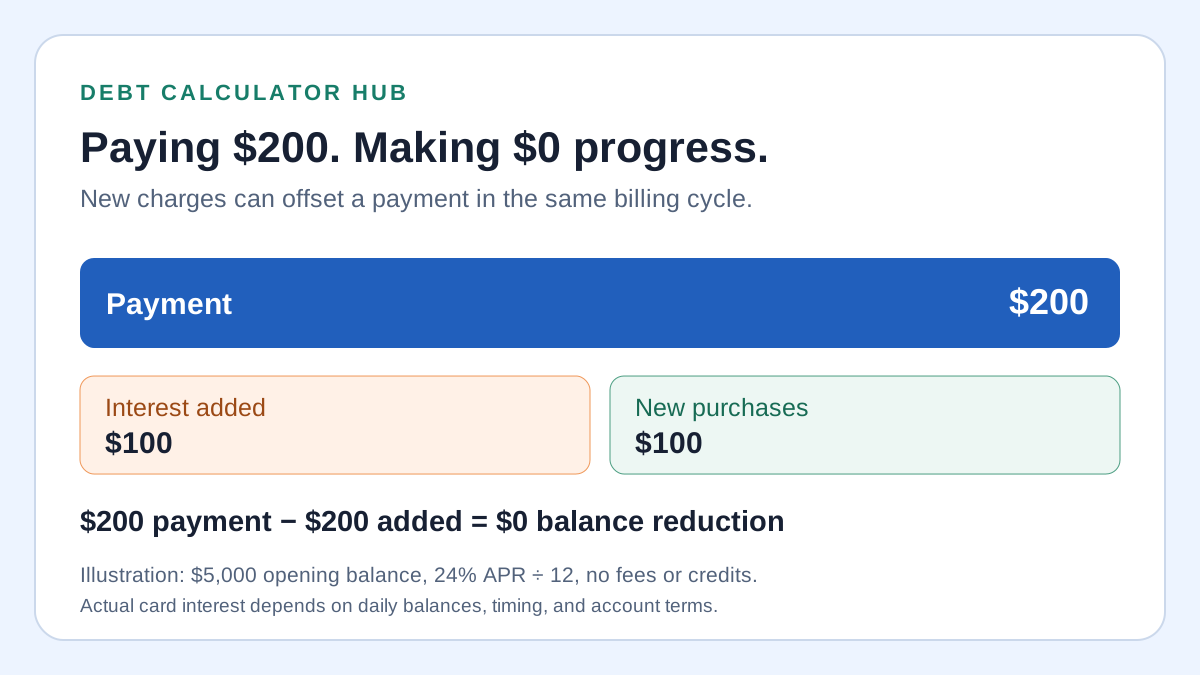
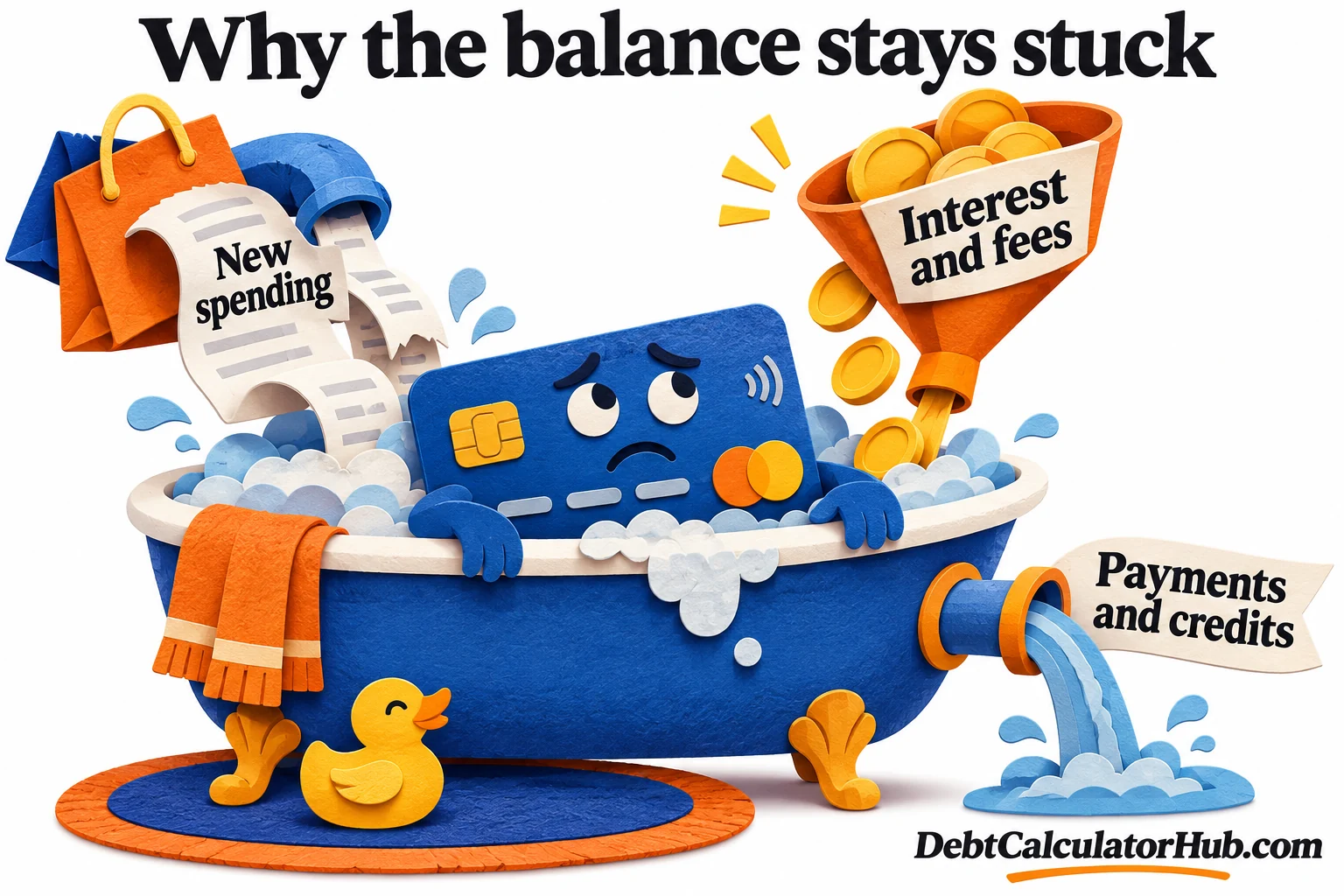
Your balance falls when payments and credits exceed purchases, advances, transfers, interest, and fees added over the same period. Paying on time matters, but paying on time and reducing debt are different things. If you pay $200 and the account adds $200 in charges, the balance ends where it started.
Start by comparing two consecutive statements. An app's current balance can include transactions after the statement closed, so comparing it with last month's statement balance can make progress look smaller than it was. First reconcile the statement period; then examine activity since that closing date.
A statement check you can do in five minutes
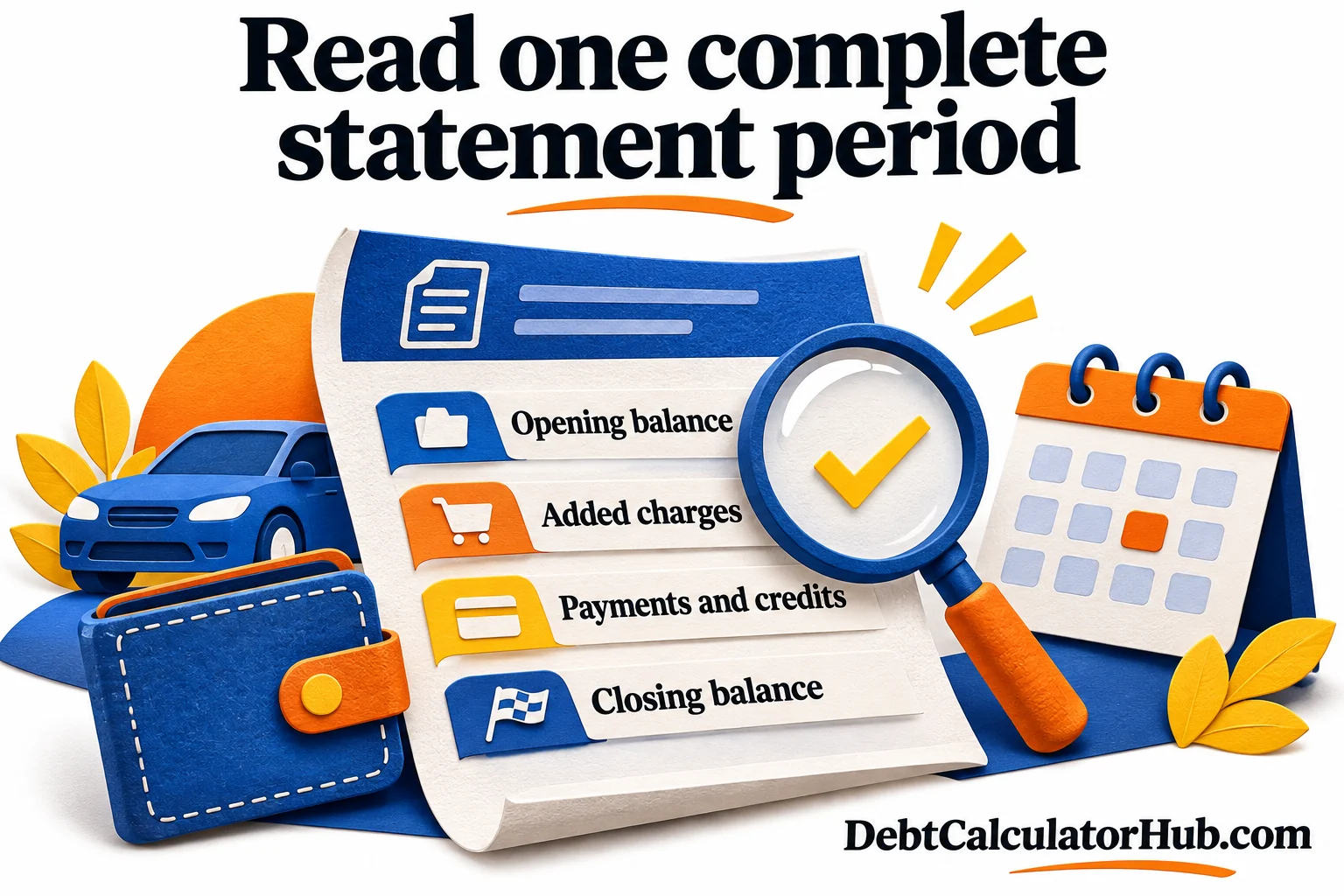
Use the account summary on a statement, rather than estimating from memory. Group payments and other credits together, then account for every item that adds to the balance. A refund or adjustment may explain part of the movement even when your payment stayed the same.
Closing balance = opening balance + new transactions + interest + fees − payments − other credits.
Include all applicable advances and balance transfers in new transactions. A transfer fee belongs under fees, not under the transferred amount a second time. Use each posted item once.
| Statement item | What to record | What it tells you |
|---|---|---|
| Previous balance | The opening amount for this billing period | Your starting point |
| Payments and credits | Posted payments, refunds, and adjustments | Amounts that reduce the balance |
| New transactions | Purchases, advances, and transfers | Borrowing added during the period |
| Interest and fees | The actual statement totals | Costs that offset your payments |
| New balance | The statement's closing amount | The figure your reconciliation should match |
If the figures do not match, check transaction dates, refunds, and adjustments before assuming that the interest is wrong. If a payment is missing, use your bank's confirmation and the card's posted-payment history to identify the discrepancy.
Worked example: a $200 payment that produces no progress
Suppose the opening balance is $5,000 at 24% APR. For this simplified example, interest is 24% ÷ 12 × $5,000 = $100. The payment is $200, with no fees or other credits. Only new spending changes across these four scenarios.
| New purchases | Interest | Payment | Closing balance | Balance reduction |
|---|---|---|---|---|
| $0 | $100 | $200 | $4,900 | $100 |
| $50 | $100 | $200 | $4,950 | $50 |
| $100 | $100 | $200 | $5,000 | $0 |
| $150 | $100 | $200 | $5,050 | −$50: balance increases |
In the third row, half the payment offsets interest and the other half offsets new borrowing. In the last row, the balance grows even though the full $200 payment was made. If a hypothetical $25 fee were added to the third row, the closing balance would instead be $5,025.
This is a teaching model, not a prediction of your next statement. It applies one month's interest to the opening balance and then adds purchases and subtracts the payment. Many issuers use average daily balances; transaction dates, payment dates, multiple APRs, and grace-period rules change the actual interest. Use the interest charged on your statement for an exact reconciliation.
Six reasons the balance can appear stuck
1. New purchases are replacing the amount you repay
Review recurring subscriptions and routine spending as well as large purchases. A $150 payment can seem substantial until the same card records $120 of groceries, transport, or subscriptions plus interest. Reconcile spending without treating it as a personal failure: if essentials still require borrowing, a larger automatic payment alone may not solve the cash-flow gap.
2. Interest is absorbing much of the payment
The APR is annual, but many card issuers calculate charges using daily balances. With interest-bearing debt, an earlier payment can reduce the balance on which later interest is calculated. Check the actual interest amount and each APR category on your statement. Our guide to minimum-payment costs explains why a small required payment may produce slow progress.
3. A lost grace period makes new purchases more expensive
For cards that offer a purchase grace period, carrying a balance can remove that interest-free window. New purchases may then accrue interest from their transaction dates. Do not assume that a purchase made after your payment is interest-free. Ask the issuer what is required to restore your grace period, especially if you have different balance categories.
4. Fees or a changed rate are adding costs
Read the fees and interest sections separately. An annual fee, transfer fee, or late-payment fee can offset progress in a particular month. A promotional rate ending may also change the interest charge. Check the agreement and statement notices for your actual rate and terms; there is no single fee amount or APR that applies to every card.
5. You are comparing different dates or a payment has not posted
Compare statement closing balances across complete billing cycles. Then inspect later activity separately. A bank account showing a payment leaving does not, by itself, explain how that payment appears in the card's current balance. If a payment is absent from the statement that should include it, contact the issuer and follow its billing-error instructions. The CFPB explains how to report a missing payment, including the written-notice deadline.
6. One balance category is shrinking while another grows
Purchases, cash advances, and promotional transfers can carry different APRs. Amounts above the minimum generally go first toward the highest-rate balance, while allocation of the minimum portion is generally determined by the issuer. Your total payment may therefore be reducing a different category than the one you are watching. Review the categories before assuming that an extra payment was ignored.
Build a realistic plan for the next billing cycle
- Find the offset. Identify how much of the last payment was offset by new transactions, interest, and fees.
- Separate new spending where affordable. If your budget allows, use available cash for purchases while repaying the card. Avoid shifting essentials to another debt simply to make one balance look better.
- Choose an affordable payment. Keep essential bills funded. A payment you can repeat is more useful than one that forces you to borrow again immediately.
- Test the existing balance. Enter the current balance, APR, and planned fixed payment in the credit card payoff calculator. Its no-new-borrowing assumption is crucial: continuing purchases will change the result.
- Reconcile the next statement. Compare the same opening-to-closing period and check whether the offset is smaller.
For a chosen deadline, use the payoff-by-months calculator to estimate a monthly payment, then check whether it fits your cash flow. For longer-term payoff habits, read how to pay off credit card debt faster.
If you cannot afford the required minimum, contact the issuer promptly about hardship options. Explain what you can afford and how long the difficulty may last. The CFPB's guidance on unaffordable card bills also discusses credit counseling. Ask about fees and terms before agreeing to a service.
Common questions
Why does my balance increase even when I pay more than the minimum?
The minimum is a required payment amount, not a promise that the total balance will fall. Add the period's new transactions, interest, and fees, then subtract payments and credits. If additions are larger, the balance increases.
Why did interest appear after I thought I paid the card off?
If you previously carried interest-bearing debt, interest may have accrued between the statement date and receipt of your payment. Check for new purchases as well. Ask the issuer what amount is needed to clear the account and how any remaining interest will be handled, rather than assuming the previous statement balance is always a final payoff figure.
Does the three-year payment figure on my statement include future spending?
No. The payoff disclosures are based on the statement balance and assume no additional purchases. New spending can move the payoff date even when you make the displayed payment.
Estimate a payment that reduces the existing debt
Once you have reconciled your statement, compare fixed payments with no new purchases. Check the assumptions against your account before setting a budget.
Estimate credit card payoffSources and calculation notes
The statement worksheet and arithmetic examples are original educational illustrations. The account rules discussed above are based on these primary sources:
- CFPB: interest calculations and payment allocation
- CFPB: purchase grace periods
- CFPB: assumptions behind statement payoff disclosures
- CFPB: when card interest rates can change
- CFPB: interest accrued before payment is received
Reviewed October 22, 2026. Educational information, not individualized financial advice. The issuer's actual statement and agreement govern your account. See our calculation methodology for the limitations of monthly payoff estimates.