
By Debt Calculator Hub · Published November 3, 2026 · Methods and editorial standards
The short answer
Look for the lender’s posted payment breakdown and the principal balance before and after it. The payment total, the principal reduction and the next amount due are different figures. A later due date alone cannot tell you how the money was allocated.
This guide focuses on a simple-interest auto loan. Credit cards, mortgages, student loans and precomputed-interest contracts can have different rules. The numbers below are our hypothetical monthly example, not a real statement or a lender’s instructions.
“I paid $100 extra” does not mean “$300 went to principal”
On an auto loan, the lender generally applies a payment to fees due and accrued interest before principal. The CFPB explains this allocation order and recommends checking your statement. Ask your lender how to request additional principal payments under your contract.
Calling a transfer “principal-only” does not erase interest or fees already due. Before using an extra-payment option, confirm whether your normal payment has posted and what the separate payment will do. Keep enough money for the next required payment while you resolve any uncertainty.
Follow a hypothetical $300 payment
Start with $5,000 of principal. For this example only, use 12% annual interest divided into twelve equal monthly periods: $5,000 × 0.12 ÷ 12 = $50 interest. Assume a separate $10 fee is already due and both charges are paid before principal. The regular payment is $200; an extra $100 makes the total $300. Actual daily-interest statements will depend on posting dates and contract terms.

| Statement item | Regular payment | With $100 extra |
|---|---|---|
| Total payment | $200.00 | $300.00 |
| Fee paid | $10.00 | $10.00 |
| Interest paid | $50.00 | $50.00 |
| Principal paid | $140.00 | $240.00 |
| Principal remaining | $4,860.00 | $4,760.00 |
The reconciliation is $300 − $10 − $50 = $240 toward principal, followed by $5,000 − $240 = $4,760 remaining principal. Compared with paying $200 under these same assumptions, the extra $100 reduces principal by an additional $100. It does not turn the entire $300 into principal.
If the next period also uses 1% monthly interest, the two remaining balances generate $48.60 versus $47.60 before the next payment: a $1 difference for that period. This illustrates why timing and principal matter; it is not a full-term savings quote. We assume no new fees, reversals, capitalized interest or other balance adjustments. A contract with precomputed interest needs a different analysis: CFPB distinguishes simple and precomputed interest.
Four checks after the extra payment
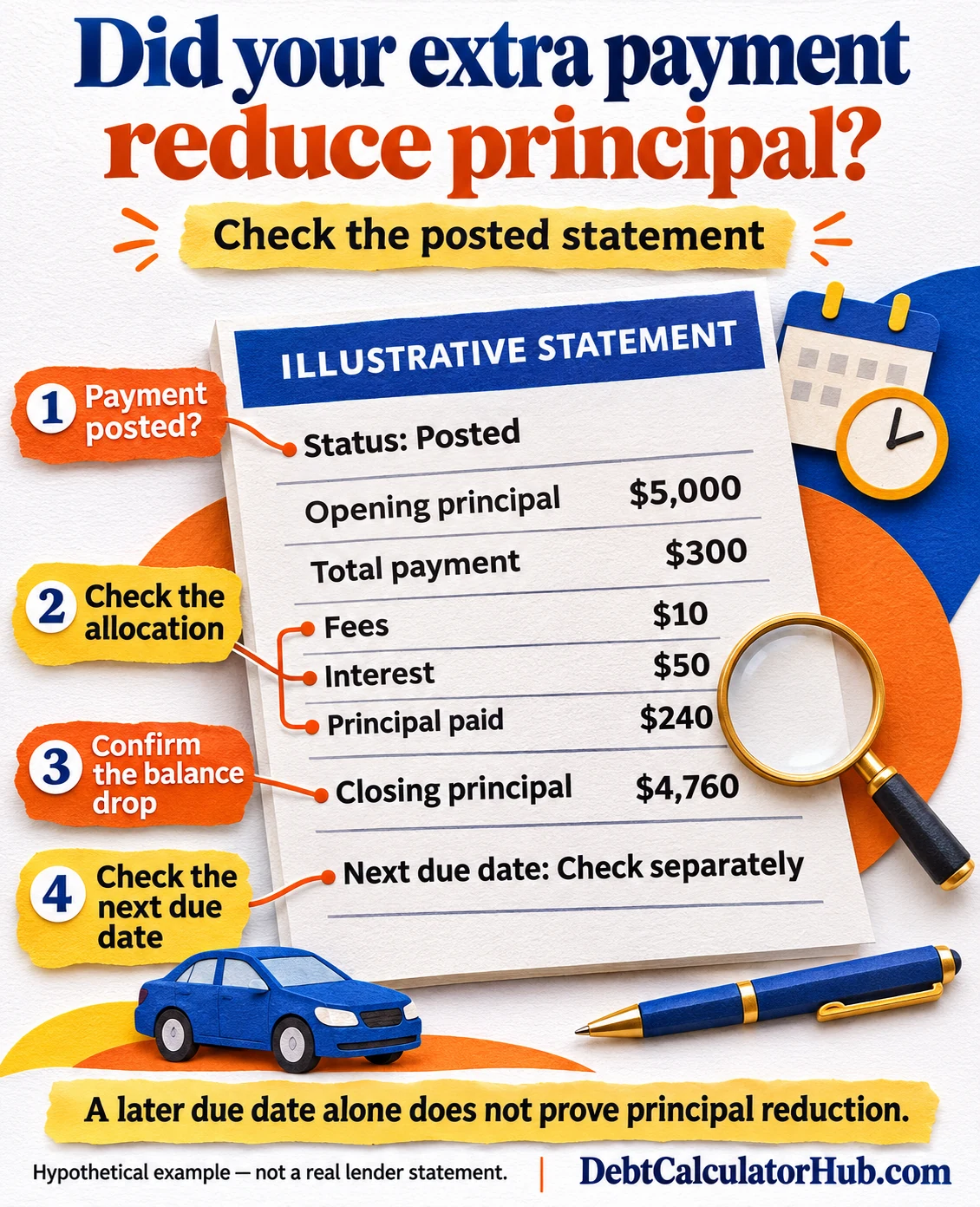
- Confirm the payment posted. A bank debit, a scheduled transfer and a posted lender transaction are different records. Match the amount and posting date using the lender’s own history. If it remains pending, use the lender’s stated processing time and ask about an unexplained delay.
- Find the allocation. Locate the fee, interest and principal portions. The dashboard’s “balance” may not use the same definition as “principal outstanding.” If there is no split, request one rather than treating the entire payment as principal.
- Reconcile the principal. Compare the same type of balance immediately before and after posting. Subtract the principal portion, then account for any separately documented adjustments. Another payment, a reversal or a correction between the two snapshots makes a simple subtraction incomplete.
- Check the next due date separately. Confirm whether the regular payment remains due and whether automatic payments will continue. Do not cancel or skip a payment solely because the date moved. The allocation record answers where the money went; the schedule answers what you must pay next.
What if the amount due falls but principal does not seem to?
First, check whether you are comparing a total balance with a principal-only balance, and whether the payment has finished posting. Next, look for interest, fees or adjustments. If the statement still does not reconcile, ask the lender for a written transaction breakdown and the effective date used.
Do not automatically apply student-loan terminology to an auto loan. The CFPB describes paid-ahead treatment for student loans; that is a product-specific explanation. For your auto loan, ask what an advanced due date means under its own payment rules.
Questions to ask your lender
Use your lender’s verified contact channel. You can adapt these questions without sharing account information with this website:
- How was my posted payment divided between fees, interest and principal?
- What were the principal balances immediately before and after it posted?
- Did you change my next due date or automatic payment amount?
- How should I submit a future additional principal payment after my regular payment?
- Does my contract include precomputed interest or a prepayment charge?
Keep the response and payment confirmation with your records. For auto loans, CFPB notes that prepayment charges depend on the contract and applicable state law. This guide does not decide whether a particular charge is permitted.
Plan the next payment using the verified principal
Once the lender confirms the current principal and normal payment, use the extra payment calculator to compare a steady monthly extra amount. The calculator uses monthly interest and excludes fees; it will not reproduce the $10 fee in this article or every daily posting detail.
For a longer schedule, the complete free debt planner supports month-specific extra amounts. It is a planning workbook, not a statement reader or a lender connection. Read how extra payments reduce interest for the full savings example. When you are ready to pay the loan in full, request a dated quote; the payoff amount can differ from the displayed balance.
Sources and example assumptions
Official CFPB sources are linked beside the relevant statements above. Reviewed November 3, 2026. The allocation order is described for auto loans; the student-loan source is explicitly limited to that product. Our $300 example and the diagrams are original hypothetical illustrations using a 12% annual rate, monthly interest, a stated $10 fee and no other adjustments. They do not represent an actual lender or customer.
Check your contract and lender records for account-specific decisions. See our methodology and editorial standards. Do not send account numbers, statements or payment instructions through this site.