
By Debt Calculator Hub · Updated November 4, 2026 · Methods and editorial standards

The main benefit
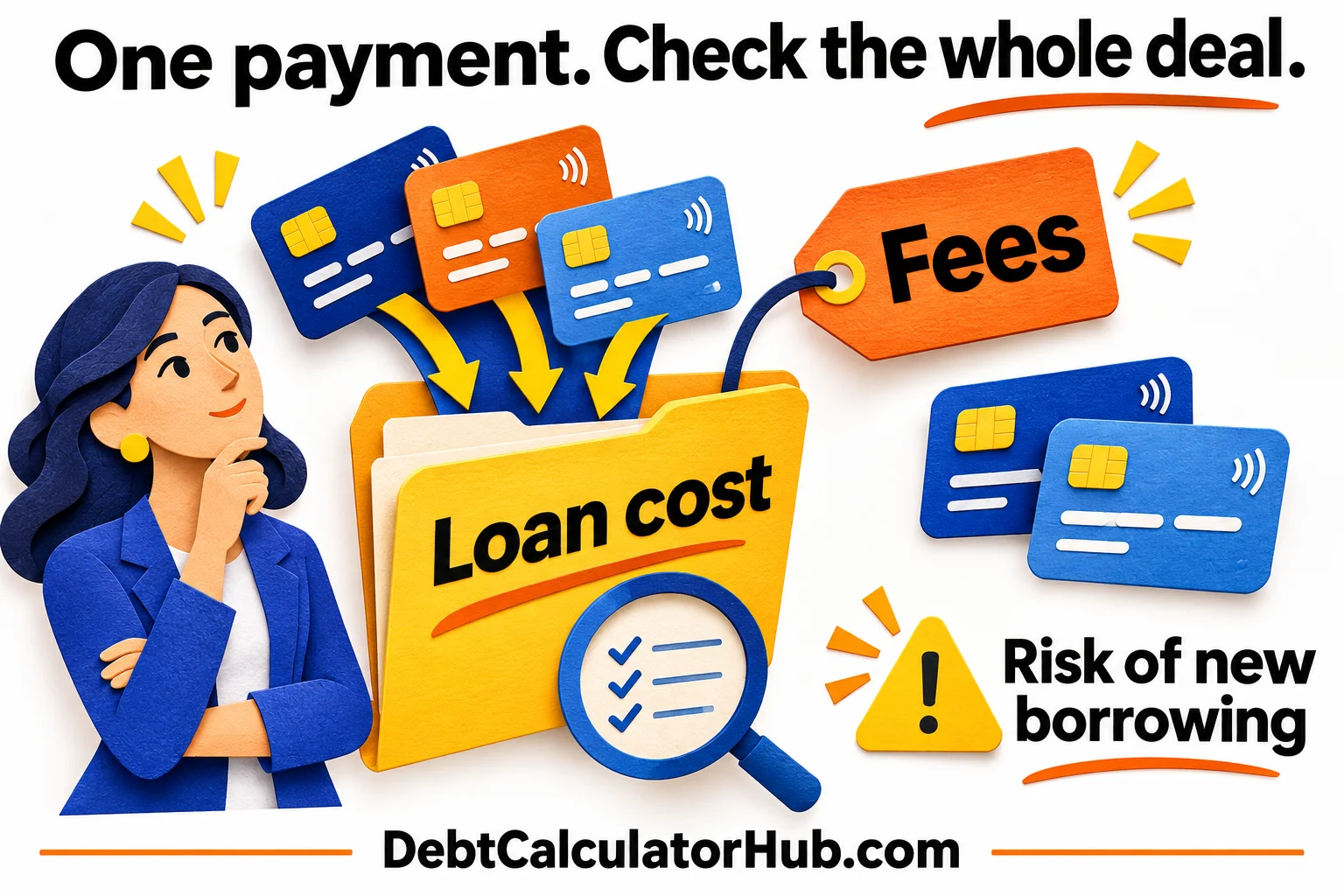
Debt consolidation can turn several payments into one payment. That can make budgeting easier and create a clearer payoff date. If the consolidation APR is lower than your current debt APR, it may also reduce total interest.
For some people, one payment is easier to organize. Instead of tracking multiple due dates, minimum payments, and interest rates, you may have one payment and one lender. That simplicity can make it easier to stay organized.
The main risk
A lower monthly payment does not always mean a cheaper payoff. If the new loan stretches the debt over a longer term, total interest can rise even when the APR is lower. Fees can also reduce or erase the savings.
Another risk is renewed borrowing. If you use a consolidation loan to pay off credit cards, those card limits may become available again. If spending continues, the total debt can grow quickly.
What to check before applying
Before applying, compare your current payoff path with the consolidation offer. Look at APR, term length, monthly payment, origination fees, and total interest. Do not judge the offer only by whether the monthly payment is smaller.
Also check whether the APR is fixed or variable. A fixed rate makes planning easier. A variable rate may change over time, which can affect payment comfort and total cost.
When consolidation can help
Consolidation can help when you have high-interest credit card debt, qualify for a meaningfully lower rate, and want a fixed payoff schedule. It can also help when multiple payments are causing missed due dates or budgeting confusion.
It works best alongside a sustainable budget and a pause in new card charges. Disabling purchases in an issuer app is different from closing an account. Consider available credit and utilization before deciding to close a paid-off revolving account.
When to be careful
Be careful if the new loan payment is lower only because the term is much longer. Also be careful if the loan includes high fees, prepayment penalties, or add-on products you do not need.
If your income is unstable, a fixed loan payment can be stressful. Credit cards are expensive, but minimum payments can adjust as balances fall. A loan payment is usually fixed. Make sure the payment fits before committing.
A simple comparison framework
Ask four questions. First, does the new APR clearly beat the current average APR? Second, do fees still leave real savings? Third, is the payoff term reasonable? Fourth, will you avoid building new balances after consolidating?
If the answer is yes to all four, consolidation may be worth exploring. If one answer is no, slow down and compare alternatives.
Practical rule
Debt consolidation should simplify payoff and reduce cost. If it only delays the problem, it is not a real solution. Use the calculator first, then read lender terms carefully before applying. A good consolidation plan should make the path clearer, not just make the monthly payment look smaller.
Questions to ask a lender
Before accepting a consolidation loan, ask whether the rate is fixed, whether there is an origination fee, whether there are prepayment penalties, and when the first payment is due. Ask whether the funds are sent directly to creditors or deposited into your account. Direct payoff can reduce the temptation to use the money for something else.
Also ask what happens if you pay extra. A good payoff plan should allow additional principal payments without punishment. If the lender charges fees that make early payoff difficult, compare another offer.
How to know if the plan is working
After consolidating, the first sign of success is that old balances stay at zero. The second sign is that the new loan balance falls steadily. The third sign is that your budget feels clearer, not tighter.
If you consolidate and then start using the old cards again, the plan is failing even if the new loan payment is current. Consolidation works best as part of a reset: one payment, no new balances, and a clear payoff date.
A fee can change how much debt you actually clear
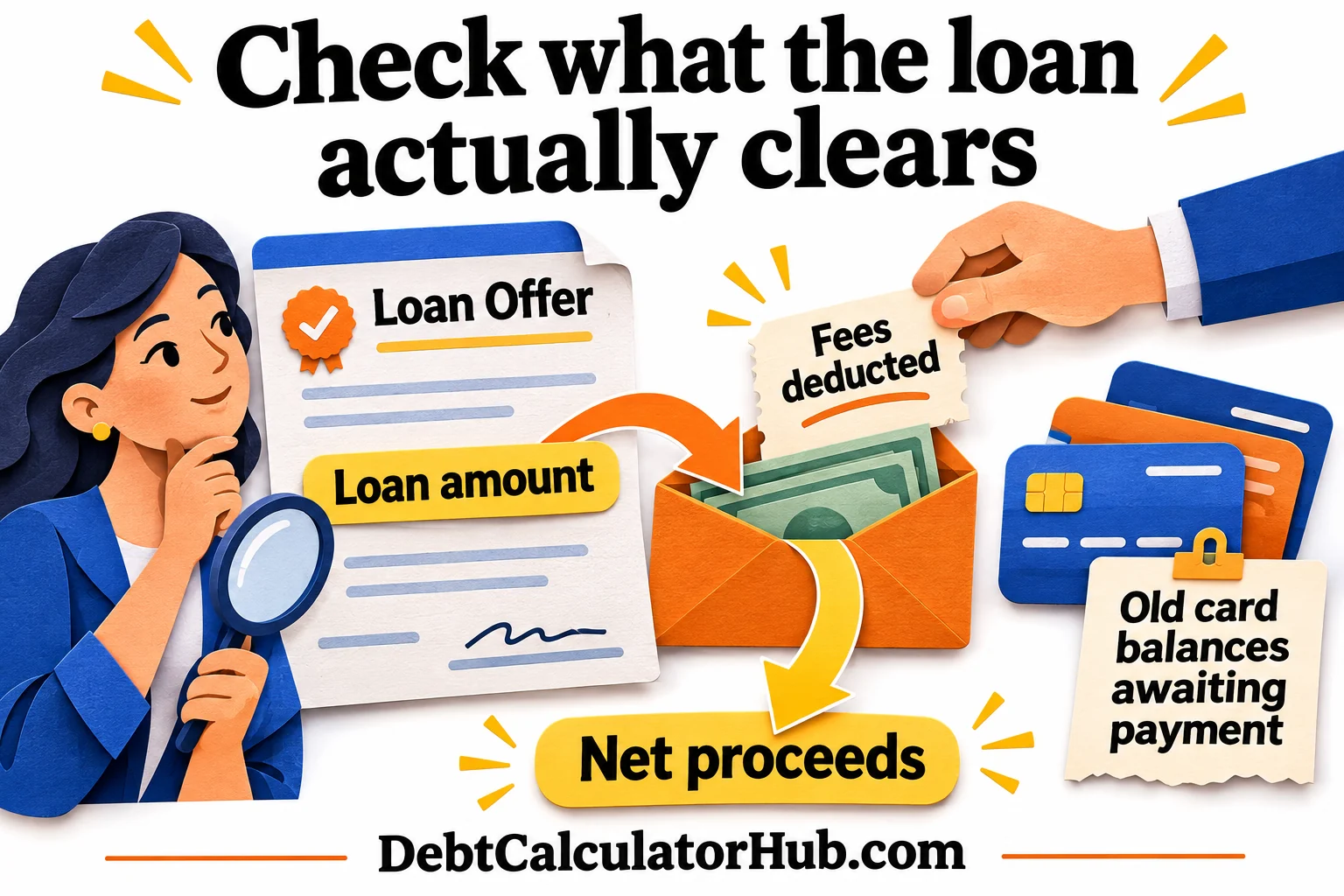
If $10,000 of debt is consolidated with a 5% fee added to the new balance, interest starts accruing on $10,500. If instead the lender deducts a 5% fee from a $10,000 loan, only $9,500 is available to pay the old debt. These are different cash flows, even when the advertised percentage is the same.
Ask for the amount financed, proceeds received, payment, number of payments, and total repayment. Compare those numbers with keeping your current payment unchanged. A smaller monthly bill alone does not establish a saving.
To prevent new charges, you may pause card use or disable the card in the issuer's app. Closing a revolving account is a separate decision: losing available credit can change utilization. Paying a balance off does not require closing the card.
Use the related calculator
Turn this guide into a concrete estimate with the calculator built for this topic.
Use the Debt Consolidation CalculatorBuild a proceeds check before signing
Put the old debts to be cleared in one column and the lender’s net proceeds in another. If $10,000 must reach creditors and 5% is withheld from the gross loan, the gross amount must be at least $10,000 ÷ 0.95 = $10,526.32, subject to the lender’s rounding. A $10,000 advertised loan would leave a $500 shortfall.
Then record the fee in dollars, interest rate, payment, number of payments, total repayment and any debt left outside the loan. Do not count a financed fee twice in total repayment. Use the interactive offer comparison to test the two fee treatments. Confirm the actual lender disclosure: the worksheet does not establish eligibility or whether that gross amount is available.
Sources and calculation notes
Our examples use the simplified monthly estimates described in our methodology. For the real-world terms and details discussed in this guide, consult these primary sources:
- CFPB: questions to consider before consolidating credit card debt
- CFPB: how debt consolidation differs from counseling, settlement, and credit repair
- CFPB: evaluating companies that advertise debt consolidation
Reviewed October 22, 2026. Examples are illustrations, not lender offers or account-specific payoff quotes. Actual terms and results depend on your account and lender.